The mission of the Raleigh Historic Development Commission is to identify, preserve, protect, and promote Raleigh’s historic resources.

Our Mission
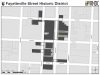
Fayetteville Street Historic District
Buildings dating from 1874
Raleigh's main street has seen architectural flamboyance and shifting fortunes
The oldest surviving buildings on Fayetteville Street reflect the ambition and success of Raleigh's businessmen in the years following the Civil War. Briggs Hardware, for instance, opened on Fayetteville Street immediately after the war. By 1874, Briggs replaced its first building with a towering four-story structure with cast-iron lion heads and an elaborate bracketed cornice of pressed sheet metal.
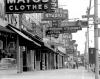
In the early twentieth century, a proliferation of two- to four-story brick commercial buildings on Fayetteville and S. Wilmington Streets housed Raleigh's white commercial center. In the 1920s, architectural competitiveness and a building boom contributed to the vertical growth of the city as showy skyscrapers clustered on and around Fayetteville Street. Architectural styles on the street include Italianate, Second Empire, Classical Revival, and Art Deco. A second skyscraper boom in the 1960s introduced Modernist towers into the skyline.
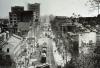
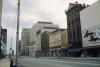
In the mid-twentieth century, retail establishments updated their store buildings at the ground floor in order to look current to shoppers, but the upper stories still show their nineteenth- and early-twentieth-century pedigree. Trying to revitalize the area in the 1970s, the city converted the blocks just south of the Capitol into a pedestrian mall. By the twenty-first century, the city deemed the project a failure and removed the mall and restored vehicular traffic. Several of Fayetteville Street's neglected retail houses have been rehabilitated and put into use as offices and restaurants.
Maps
 |
Fayetteville Street in the 21st Century
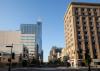 Photo by Michael Zirkle Photography Photo by Michael Zirkle Photography |
Retrospective
   Courtesy of NC State Archives Courtesy of NC State Archives |
